Introduction
When most people hear "ultrasonic cleaner," they probably think of jewelry, eyeglasses, or small metal tools. But these are only a few of its possible uses. The real advantage of ultrasonic cleaning becomes more obvious when an object has narrow gaps, small holes, textured surfaces, or areas that are difficult to reach with a brush.
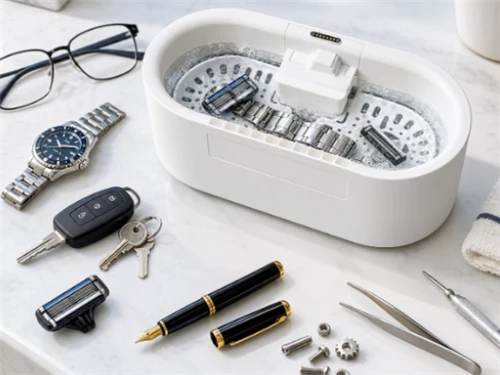
This is where many everyday cleaning problems begin. A razor head can collect skin oils between small parts. A fountain pen nib can retain dried ink around its feed. A key can hold dirt inside its grooves even after wiping. Small mechanical parts may look clean on the outside while grease remains inside narrow passages.
Ultrasonic cleaning works through cavitation, which means microscopic bubbles form and collapse rapidly in a cleaning liquid. The movement created by these bubbles helps loosen contaminants from surfaces and recessed areas without relying on aggressive brushing. The method is widely used for jewelry, tools, automotive components, medical instruments, and other small parts. (Engineer Fix)
However, "can be submerged" does not automatically mean "is safe to clean." Material, coatings, adhesives, seals, and the condition of the object all matter. The following seven examples show where ultrasonic cleaning can be surprisingly useful and where you should use some judgment before starting a cycle.

Portable ultrasonic cleaner cleaning household items
1. Retainers and Mouthguards
Dental retainers and mouthguards are good examples of objects that can be difficult to clean thoroughly by hand. Their surfaces contain edges, recesses, and small areas where residue can accumulate.
A portable ultrasonic cleaner can be useful when the appliance is designed for immersion and its manufacturer does not prohibit ultrasonic cleaning. Instead of relying entirely on a toothbrush to reach every small area, ultrasonic energy can help loosen deposits from less accessible surfaces.
The important point is not to assume that every dental appliance is suitable. Check the manufacturer's care instructions first, particularly for appliances containing special coatings, bonded components, or materials that may react to heat or cleaning chemicals.
For routine cleaning, use a solution appropriate for the appliance and avoid unnecessarily long or hot cycles. Ultrasonic cleaning should supplement proper oral-appliance care rather than replace the cleaning instructions provided by the manufacturer.
2. Razor Heads and Grooming Tools
Razor heads, tweezers, eyelash curlers, and similar grooming tools are another practical application.
These products are often exposed to skin oils, cosmetic residue, hair, and moisture. The problem is that contamination does not always remain on the most visible surfaces. It can collect around joints, edges, and small gaps.
For example, a metal tweezer may look clean after wiping, while residue remains around its hinge or textured gripping area. An ultrasonic bath can help loosen this buildup without requiring the user to scrub every recess manually. Makeup tools such as eyelash curlers and tweezers are also commonly listed among suitable applications for ultrasonic cleaning. (Akuasonic)
Before cleaning, remove anything that should not be immersed, including batteries or electronic components. For grooming tools made from multiple materials, check whether rubber, adhesive, paint, or delicate coatings are present.
The goal is not maximum cleaning power. A short, controlled cycle is generally preferable to repeatedly exposing a delicate item to unnecessary ultrasonic energy.
3. Keys and Small Metal Hardware
House keys may not seem like something that needs specialized cleaning, but they are an excellent example of an object with difficult-to-reach surfaces.
The grooves and cuts on a key can trap dust, skin oils, and other residue. Key rings, clips, small metal fasteners, and similar hardware can have the same problem.
Dense, non-porous metals are generally among the easier materials to clean ultrasonically. (Sonirity) The advantage is especially noticeable when an object has detailed geometry that makes manual brushing inconvenient.
If you are cleaning keys, separate them from electronic key fobs or remote controls. The metal key itself may tolerate immersion, while the electronic component certainly may not.
This distinction is useful in real-world cleaning: clean the part that is suitable for immersion, not necessarily the entire product.
4. Fountain Pens and Small Writing Tools
A fountain pen is a surprisingly good example of why ultrasonic cleaning can be useful.
Ink can dry around the nib and feed, creating residue in narrow channels that are difficult to reach with a cloth. These small passages are exactly the type of geometry where ultrasonic cleaning can provide an advantage.
Fountain pens are also specifically listed among ultrasonic-cleaning applications by consumer ultrasonic cleaner manufacturers. (Akuasonic)
However, the pen should not simply be dropped into the tank as a complete assembly. Remove components according to the pen manufacturer's design and determine which parts are suitable for immersion. Materials such as wood, decorative coatings, adhesives, or sensitive finishes require additional caution.
For valuable or collectible pens, a conservative approach is better. If you are unsure about a particular material or construction method, consult the manufacturer or an experienced pen specialist before cleaning.
5. Small Automotive Parts
This is where ultrasonic cleaning moves from an unusual household application to a practical maintenance tool.
Small automotive components can contain oil, grease, carbon deposits, and other contaminants that accumulate in narrow passages. Carburetor components are a common example because internal channels and openings can be difficult to clean thoroughly with a brush.
Ultrasonic cleaning is particularly useful for parts with blind holes, meaning holes or passages that do not extend completely through the component. Cavitation can reach areas that are difficult to access mechanically, helping loosen contaminants without requiring every passage to be physically brushed. (Sonirity)
A practical workflow is:
- Remove heavy grease and loose debris first.
- Disassemble the component as far as recommended.
- Select a cleaning solution compatible with the material.
- Place the parts so that the solution can reach all surfaces.
- Run a controlled cycle and inspect the result.
- Rinse and dry the parts thoroughly.
Do not assume that every automotive component belongs in an ultrasonic tank. Rubber seals, certain coatings, electronic modules, and glued assemblies may require separate treatment.
6. Brass Musical Instrument Parts
Small brass instrument components can also benefit from ultrasonic cleaning. Mouthpieces and other suitable metal parts may accumulate oils, dirt, and residue in areas that are inconvenient to clean manually.
The important distinction is material compatibility. Brass components can be suitable, while wood and other moisture-sensitive materials can present very different risks. OmegaSonics, for example, specifically notes that brass instruments can be cleaned ultrasonically but warns against putting wood instruments into the bath because moisture can cause warping or cracking. (Omegasonics)
For musicians, this means the instrument should be separated into components before cleaning. Do not treat an entire instrument as one cleaning object simply because one of its parts is compatible.
After cleaning, rinse and dry the component properly before reassembly. This is especially important for parts that connect directly to other precision components.
7. Coins and Small Collectibles
Coins, metal collectibles, decorative hardware, and other small objects can be tempting candidates for ultrasonic cleaning because dirt often collects in engraved details.
For an ordinary metal object, ultrasonic cleaning may remove surface contamination from grooves more effectively than wiping alone. Coins and small collectibles are therefore frequently included in lists of potential ultrasonic-cleaning applications. (Akuasonic)
But this is also one situation where cleaning may actually reduce the value of an object.
A collectible coin should not be treated like an ordinary dirty piece of metal. Removing its original surface condition, patina, or finish may affect its appearance and collectibility. If the object has significant monetary or historical value, professional advice should come before cleaning.
The same principle applies to antiques, painted objects, plated surfaces, and anything where the original finish is part of its value.
Why Material Matters More Than the Object Name
One of the most important lessons from ultrasonic cleaning is that there is no universal "safe items" list.
Two objects that look similar may require completely different cleaning methods. A solid stainless-steel component is very different from a painted component made from the same base material. A metal watch bracelet is different from a complete watch containing a movement. A hard gemstone is different from a porous or delicate stone.
Before using a Portable Ultrasonic Cleaner, ask three practical questions:
1. Can the item safely be immersed?
If water or another cleaning liquid can damage the item, ultrasonic cleaning is not appropriate.
2. Does it contain vulnerable materials?
Check for pearls, opals, porous stones, loose coatings, paint, rubber, adhesives, wood, or other sensitive materials. Several ultrasonic-cleaning guides specifically recommend avoiding porous gemstones, damaged coatings, glued components, and watch movements. (Akuasonic)
3. Can it be dried completely afterward?
Moisture trapped inside a cavity can create a new problem after cleaning. Parts should be positioned and dried in a way that prevents water from remaining inside openings or joints.

Meare Portable Ultrasonic Cleaner
How to Get Better Results from an Ultrasonic Cleaner
Good results depend on more than putting an item into the tank and pressing the start button.
First, remove loose dirt and heavy contamination. Ultrasonic cleaning is excellent for reaching difficult areas, but it does not eliminate the need for sensible preparation.
Second, choose a cleaning solution that matches the material and contaminant. Oil, mineral residue, and general dirt may require different formulations. Avoid combustible liquids unless the equipment manufacturer specifically approves them.
Third, do not automatically choose the longest cycle. A longer cycle is not necessarily a better cycle. Start with a conservative setting, inspect the result, and increase cleaning time only when necessary.
Finally, rinse and dry the item after cleaning. Residual cleaning solution can remain on the surface if the part is not properly rinsed.
Conclusion
The most useful way to think about ultrasonic cleaning is not simply "What objects can I put into the machine?" Instead, ask whether the object has hard-to-reach contamination, can tolerate immersion, and can be safely dried afterward.
Retainers, grooming tools, keys, fountain pens, small automotive components, brass instrument parts, and ordinary metal collectibles can all demonstrate the practical value of ultrasonic cleaning. But each application still requires a material check before the first cycle.
If you are trying an unfamiliar item, start with the manufacturer's cleaning instructions, remove sensitive components, use a compatible solution, and choose a short, conservative cycle. Inspect the item afterward before repeating or increasing the cleaning process.
That approach turns ultrasonic cleaning from a simple "put it in and switch it on" process into a controlled cleaning method that is more useful, repeatable, and safer for valuable or delicate items.
FAQ
Can I clean anything made of metal with an ultrasonic cleaner?
No. Many dense metals are suitable, but the complete item may also contain coatings, adhesives, rubber, paint, or other vulnerable materials. Check the construction rather than judging the item only by its outer metal surface.
How long should I run an ultrasonic cleaner?
There is no universal cycle time. The appropriate duration depends on the material, contamination, cleaning solution, frequency, and equipment. Start with a short cycle and inspect the item before extending the cleaning time.
Can ultrasonic cleaning damage delicate items?
Yes. Ultrasonic cavitation is useful but powerful. Porous gemstones, damaged coatings, glued components, some plastics, rubber parts, and sensitive assemblies can be damaged. Manufacturer guidance should take priority when the material is uncertain. (Akuasonic)
Can I clean electronics in an ultrasonic cleaner?
Some specialized electronic components may be cleaned under controlled conditions, but complete consumer electronics should not be treated as automatically suitable. Devices with batteries, screens, speakers, sealed assemblies, or other water-sensitive components require particular caution. (Omegasonics)
Is ultrasonic cleaning better than manual cleaning?
It depends on the object. Ultrasonic cleaning is especially useful when dirt is trapped in grooves, narrow passages, joints, or recessed areas that are difficult to reach manually. For large, easily accessible surfaces, conventional cleaning may be faster and simpler.