The household appliance category rarely moves fast. Toasters, vacuum cleaners, kitchen bins - these are products people replace when something breaks, not because something better came along. Which makes the accelerating adoption of sensor-operated waste bins in family households worth paying attention to.
Market data tells part of the story. The global touchless trash can market was valued at over USD 1.2 billion in 2023 and is projected to grow at a compound annual rate above 6% through 2030, according to industry analysts tracking the smart home segment. What's less discussed in those reports is who is driving that growth. It isn't the early-adopter smart home crowd, who moved on this category years ago. The current growth is coming from a more specific consumer segment: households with children under eight, replacing standard bins not as a technology upgrade, but as a functional response to a set of problems that traditional designs simply weren't built to solve.
Understanding why requires looking at what actually happens in a family kitchen - and why the bin, of all things, ends up being a meaningful point of friction.
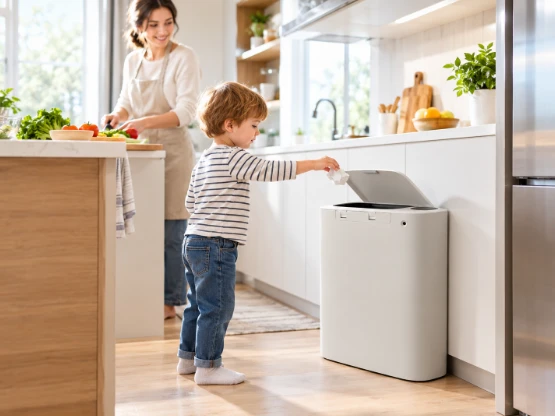
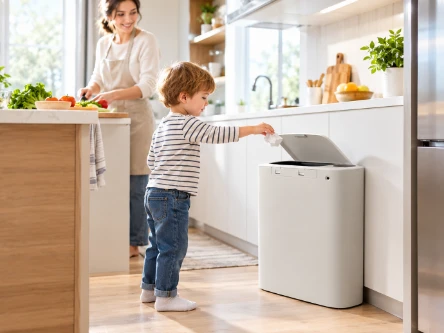
A child using a smart sensor trash can
Where the Standard Design Falls Short
The conventional trash can - whether a flip-top, a swing-lid, or a foot-pedal step can - was designed around a single-adult use case. One person, two hands, predictable behavior. The foot pedal in particular represented decades of thinking about hands-free convenience.
That thinking doesn't account for a two-year-old who can't reach the pedal and defaults to lifting the lid manually. It doesn't account for the cross-contamination chain that forms when a parent handling raw poultry touches a bin lid and then returns to a shared kitchen surface. And it doesn't account for the mechanical force of a heavy stainless lid closing on a small hand - an incident common enough that it appears consistently in consumer complaint data and parenting forums alike.
NSF International testing has identified kitchen trash cans as among the higher-bacteria-density surfaces in the average home, with E. coli and Salmonella present on exterior surfaces in a notable percentage of tested households. For adults this is manageable background risk. For toddlers - who make hand-to-face contact upward of sixteen times per hour according to University of California research - it represents a meaningfully different exposure profile.
These aren't edge cases. They're structural limitations of a product category that hasn't substantively evolved in decades, meeting a household configuration - two working parents, young children, high-frequency kitchen activity - that is now the norm rather than the exception.
What Sensor Technology Actually Changes
A touchless trash can addresses these limitations through infrared proximity detection: a sensor mounted near the lid reads motion within a calibrated range (typically 6 to 8 inches) and triggers an automated lid mechanism, which opens in under half a second and closes automatically after a set interval of 3 to 5 seconds.
The functional difference in a family context is more significant than the mechanism suggests. Contact with the bin exterior is removed entirely from the disposal sequence. The lid closes at motorized speed - controlled, consistent, and slow enough not to catch fingers - rather than under gravity or spring tension. Children from toddler age upward can operate it correctly without instruction, which removes a common source of parental intervention during meal prep.
There's a secondary effect that doesn't appear in most product descriptions: when the bin operates reliably and automatically, children's relationship with waste disposal changes. The mechanism becomes something they engage with rather than avoid. Behavioral consistency - everyone uses the bin the same way, every time - is one of the harder things to establish in early childhood habit formation, and a sensor-operated lid removes most of the variables that undermine it.
For bathroom placement, a bathroom motion sensor trash can addresses a condensed version of the same problem. The unit is smaller, sits closer to floor level, and operates in a high-humidity environment where an IPX4 moisture resistance rating (meaning protection against water splash from any direction) becomes a practical necessity rather than a specification footnote. Automatic lid closure in this context also provides passive odor control - relevant in a room with limited ventilation and contents that include hygiene products and, in households with young children, nappy disposal.
Meare Bathroom Motion Sensor Trash Can
The Space Constraint Problem, Resolved
One objection that historically slowed adoption in family households was form factor. Early sensor bin designs were larger than their manual equivalents - the motor housing, battery compartment, and sensor array added bulk that didn't fit naturally into the constrained layouts of most residential kitchens.
Current manufacturing has largely resolved this. The slim sensor trash can category now offers full sensor functionality in footprints comparable to standard rectangular manual bins, specifically engineered for the spaces that exist in real kitchens: the narrow gap between a cabinet and a wall, the corner of a bathroom, the area beneath a half-shelf. For households in urban apartments or smaller homes - which disproportionately includes young families in most major markets - this removed the last credible practical barrier to switching.
The engineering tradeoffs involved are worth understanding. Slim-profile units achieve their footprint reduction through vertical capacity optimization rather than reduced sensor capability, and the best designs maintain the same IPX4 ratings, liner retention systems, and motor cycle ratings (typically specified at 50,000 or more open-close cycles) as their larger counterparts. Capacity runs from roughly 12 liters for bathroom or bedroom placement up to 30 liters for kitchen configurations - adequate for a family of four without requiring daily liner changes.
Evaluating a Purchase: What the Specifications Actually Mean
For parents making this decision, the product category has expanded significantly and the quality range is wide. The specifications worth scrutinizing:
Sensor response time. Sub-0.5-second activation at 6-inch range is the functional benchmark. Units that respond more slowly than this create a hesitation in the disposal sequence that adults find irritating and children quickly learn to work around by lifting the lid manually - defeating the purpose.
Battery endurance under real-world conditions. Manufacturer specifications typically assume 20 openings per day. A household with two adults and two young children will realistically average 30 to 40. At that rate, a well-engineered unit on four AA alkaline batteries should deliver five to seven months of service. Budget-tier units with less efficient circuitry can exhaust the same batteries in six weeks. USB-C rechargeable lithium-ion configurations are now available at most price points and eliminate this variable entirely.
IPX4 moisture resistance. Essential for kitchen and bathroom placement. The rating indicates the electronics and battery compartment can withstand water splash from any direction - a basic requirement in an environment where sink proximity and cleaning routines create regular incidental moisture contact.
Liner retention system. A detail that has outsized impact on daily usability. Bags that migrate down inside the bin require manual retrieval - an unpleasant task that families consistently cite as a frustration point. Units with integrated retention rings or inner bucket systems that mechanically secure the liner are worth the modest cost premium.
Child and pet lock function. A manual disable mode that suspends the sensor trigger is useful in households with infants at the floor-exploration stage, or pets with strong olfactory motivation. Not a primary specification, but one worth confirming is available on whichever unit you select.
The Practical Conclusion
The shift toward sensor-operated bins in family households reflects something straightforward: a product category that was designed for a different use case is being replaced, at scale, by one that accounts for the actual conditions of modern family life. The hygiene argument is real and measurable. The safety argument - particularly around lid mechanics and finger-pinch risk - is underreported but consistently surfaces in consumer experience data. The convenience argument, though harder to quantify, is probably what sustains adoption once the initial purchase decision is made.
For families evaluating the switch, the kitchen bin is the logical starting point and the highest-impact location. Confirm IPX4 moisture resistance, verify sensor response is under 0.5 seconds, and check that the liner retention system is mechanically robust rather than relying on friction alone. These three criteria will filter out most of the underperforming units in a crowded market.
The rest - finish, form factor, power configuration - is context-dependent. But the core decision, for most families with young children, tends to resolve itself fairly quickly once the alternatives are laid out.
FAQ
Is there clinical or research evidence that sensor bins actually reduce germ transmission in households?
Direct household studies on bin-specific transmission are limited, but the underlying mechanism is well-supported. NSF International's kitchen hygiene research consistently identifies bin surfaces as high-bacteria-density contact points, and epidemiological guidance on foodborne illness prevention identifies cross-contamination via hand contact with contaminated surfaces as a primary transmission pathway. Removing the lid as a contact point during raw food handling addresses one of the more controllable links in that chain.
At what age can children use a sensor bin independently and correctly?
Most children develop the coordination and spatial awareness to approach the sensor and dispose of waste correctly somewhere between ages two and a half and three. The more relevant threshold is understanding that the bin closes on its own - children who grasp this stop attempting to hold the lid open manually, which is the behavior that leads to accidental contact. For children under two, placement matters more than the bin type: any bin within crawling reach should be treated as an access control problem regardless of lid mechanism.
Do sensor bins malfunction more than manual ones, given the electronics involved?
Quality varies significantly by manufacturer. Units from established brands with published cycle-test data (50,000 open-close cycles is a common benchmark) and IPX4 ratings perform reliably under normal household conditions for several years. The most common failure mode in lower-quality units is sensor inconsistency in humid environments - random triggering or failure to trigger - which is why moisture resistance rating is a meaningful purchase criterion rather than a marketing specification.
What happens when the battery depletes - is the bin inaccessible?
Any well-designed unit includes a manual override, typically a button on the lid housing or upper body, that allows mechanical operation when battery power is unavailable. This should be confirmed before purchase. A design that renders the bin inaccessible on battery depletion is a functional flaw, not an acceptable limitation.
Are the running costs - batteries or charging - significant over time?
At typical family usage rates on a quality unit with efficient circuitry, alkaline battery costs run to roughly USD 8 to 15 annually depending on cell type and regional pricing. USB-C rechargeable units eliminate this recurring cost at a modest upfront premium. Neither represents a significant ongoing expense relative to the purchase price of the unit.