The Problem Nobody Talks About
Here's something uncomfortable: rinsing your toothbrush under the tap after brushing does almost nothing. The water pressure isn't strong enough to dislodge bacteria packed into the base of the bristles, and the damp bathroom environment - warm, humid, often shared - is basically ideal for microbial growth. Research has found more than 10 million bacteria on a single used brush, and some of those organisms, like Streptococcus mutans and Staphylococcus aureus, aren't just "bathroom germs." They're directly linked to tooth decay, gum disease, and skin infections.
So when people start looking into a toothbrush sanitizer, the impulse is completely reasonable. What's less reasonable is how the product category is marketed. Walk through any e-commerce platform and every device - UV, ozone, or some combination of both - claims "99.9% germ elimination." The numbers are identical. The price tags are not.
So which technology is actually doing the work, and which is mostly doing the marketing?

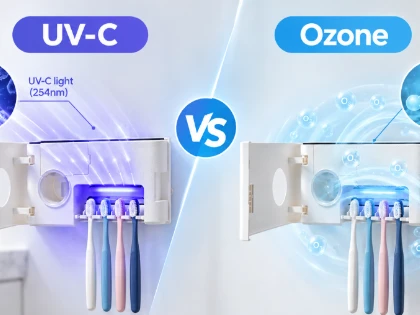
UV vs Ozone Toothbrush Sanitizer
UV-C: What the Science Is Actually Based On
UV-C light kills bacteria by damaging their DNA at a specific wavelength - 253.7 nanometers, to be exact. At this frequency, the light causes structural breaks in the DNA strand that prevent cells from reproducing. They don't explode dramatically; they just can't replicate, and they die off.
This isn't new science. UV-C has been used in hospital water purification and air sterilization systems for decades. Its application to toothbrushes is newer, but the underlying mechanism is well-understood and extensively tested. A 2023 systematic review across multiple controlled studies found bacterial reductions of 86–100% against the pathogens most relevant to oral health: S. mutans, E. coli, S. aureus, and Candida albicans.
The honest limitation of UV-C is geometry. Light travels in straight lines, and toothbrush bristles are dense. Any bristle cluster that blocks direct light creates a shadow, and bacteria in that shadow are unaffected. This is why the internal design of a UV sanitizer matters more than most buyers realize. A chamber lined with high-reflectivity material bounces light at angles the direct beam can't reach. A chamber that's just a plain plastic box with a bulb is considerably less effective than its spec sheet suggests.
One more thing worth checking before buying: not every device sold as a "UV sanitizer" actually uses UV-C. Some manufacturers install UV-A or UV-B bulbs because they're cheaper. Both are largely ineffective at the distances involved in a consumer sanitizer. If a product doesn't specifically state 254–260nm UV-C, that omission is telling you something.
Ozone: The More Complicated Story
Ozone (O₃) is a gas, which gives it one genuine advantage over light: it can move into spaces that UV-C can't reach. It works through oxidation - the ozone molecule breaks down cell membranes on contact, regardless of whether the bacteria are tucked into a bristle gap or sitting on an exposed surface.
In theory, that makes ozone the more thorough sanitizer. In practice, consumer-grade ozone generators are a different proposition than the industrial systems where ozone's effectiveness has been reliably demonstrated. The concentrations required for consistent bacterial kill in clinical settings are far higher than what a bathroom-safe device can safely emit. Many consumer ozone sanitizers produce concentrations that are inconsistent or simply below the therapeutic threshold.
Then there's the safety dimension. The FDA has been explicit: ozone inhalation is not safe, even at low concentrations. There's also an under-discussed chemical risk - residual ozone can react with ingredients in common toothpastes to produce formaldehyde derivatives. That's not a headline you'll find on any product box.
The performance data reflects this gap. Across available testing, ozone adds roughly 0.5–1% additional bacterial reduction compared to UV-C alone. That marginal difference costs an extra $20–30 at retail and comes with a set of safety considerations that most buyers are never informed about.
The Detail That Changes Everything: Wet Bristles
Neither technology works well on a soaking wet brush. Water scatters UV-C light and dilutes ozone concentration. Yet virtually no product manual makes this prominent. Shaking out excess moisture and letting the brush air for even two minutes before placing it in any sanitizer meaningfully improves results. It costs nothing and takes no extra equipment. It's also the kind of detail you only learn through trial and error - or by reading the studies the manufacturers cite but don't fully summarize.
Matching the Device to the Situation
For a single person who brushes twice a day and wants a simple, low-maintenance solution, a UV-C sanitizer with a verified 254nm wavelength, a reflective chamber, and a physical lid interlock is the right call. It works, it's safe, and it doesn't require ventilation management.
For families sharing a bathroom, the storage problem and the sanitization problem should be solved by the same device. A wall-mounted Toothbrush Holder with UV Sterilizer that holds three to five brushes handles both without adding clutter. The sanitization runs automatically as part of the storage routine, which means it actually gets used instead of sitting on the counter half the time.
For anyone who travels regularly, the shared-bathroom hygiene problem is genuinely worse - hotel environments introduce unfamiliar bacterial populations, and a brush left exposed overnight accumulates contamination faster than most people assume. A compact clip-style UV-C unit that caps directly over the brush head solves this cleanly. Three to five minutes of USB-charged treatment is a low-friction habit.
For immunocompromised users, or anyone recovering from a mouth or throat infection, the case for a dual-technology device (UV-C plus ozone) becomes more defensible - not because the marginal sterilization gain is large, but because the gas-phase penetration into dense bristle zones addresses a real, if uncommon, risk. The ventilation requirement becomes an acceptable tradeoff in that context.
When evaluating any toothbrush sanitizer for purchase, three specifications actually matter: wavelength (must be 254–260nm UV-C, not just "UV"), the presence of a physical safety interlock, and third-party lab validation of the efficacy claims. A device with CE marking, RoHS compliance, and FDA registration has been through more rigorous review than one with only its own marketing copy as evidence.

Meare Toothbrush Holder with UV Sterilizer
What to Actually Do
Stop over-relying on the rinse-and-dry routine - it creates the illusion of hygiene without delivering it. Shake excess water off your brush before any sanitization treatment, regardless of which technology you use. Choose a device that specifies its UV-C wavelength in nanometers, not just "germicidal UV." And if you're buying for a family bathroom, a Toothbrush Holder with UV Sterilizer that integrates storage and sanitization into a single wall-mounted unit will get used consistently, which matters more than marginal differences in sterilization percentage.
The gap between UV and ozone performance in real-world home use is small. The gap between consistent sanitization and none at all is not.
FAQ
Q: Do I still need to replace my toothbrush every three months if I'm using a sanitizer?
Yes. Sanitizers address bacterial load, not bristle wear. Frayed bristles don't clean effectively no matter how sterile they are. The three-month replacement schedule stands.
Q: Is ozone actually dangerous in a home bathroom?
At consumer product concentrations, it's unlikely to cause acute harm in a ventilated space. But the FDA's position against deliberate ozone inhalation is based on documented respiratory irritation effects at low levels, particularly for people with asthma or lung conditions. If ventilation is limited, UV-only is the safer default.
Q: How long does a UV-C cycle need to run?
Studies demonstrating 99%+ reduction used exposure times of three to ten minutes. Devices claiming full sterilization in under sixty seconds at consumer power levels are making claims that outrun the evidence. Check whether efficacy data comes from independent lab testing or the manufacturer's own materials.
Q: Will daily UV treatment wear out my toothbrush faster?
Probably, with daily use. Accelerated testing found visible bristle degradation in 78% of brushes after four months of daily UV exposure. Sanitizing every two to three days rather than after every single brushing is a reasonable middle ground.
Q: Can one sanitizer work for both manual and electric toothbrush heads?
It depends on the internal bracket design. Some units are sized for manual brushes only; others accommodate electric replacement heads. Full electric toothbrush handles - with the motor body attached - typically require a larger chamber. Check the internal dimensions against your brush model before buying.