Introduction: That Moment When the Water Just Won't Go Down
You step into the shower and feel water rising around your ankles. Or you watch your kitchen sink fill up slowly after washing dishes - again. Clogged drains are one of the most frustrating household problems precisely because they're invisible. You can't see what's inside the pipe, and that uncertainty is maddening: Is this something I can fix in five minutes, or do I need to call a plumber?
The answer depends entirely on what's causing the blockage. Hair, grease, and deeper structural problems each behave differently, respond to different treatments, and carry very different price tags to fix. Getting the diagnosis right the first time saves you money, prevents pipe damage, and - most importantly - actually solves the problem instead of just delaying it.
This guide gives you a clear, symptom-based framework to identify your clog type and decide your next move with confidence.

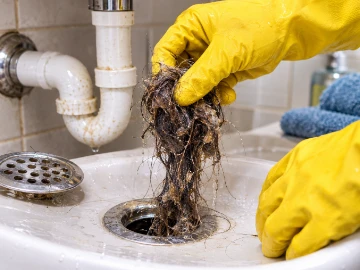
Removing Hair and Debris from a Clogged Drain
Part 1: Reading the Symptoms - Your Drain Is Telling You Something
Before reaching for any tool or product, observe what's happening. The pattern of the problem is your most reliable diagnostic clue.
Single drain affected, water pools then slowly clears?
This almost always means a localized, shallow blockage - typically hair or soap scum - sitting within a few inches of the drain opening or just past the P-trap (the curved pipe section directly under the drain, designed to hold water and block sewer gases).
Kitchen sink slow, greasy film visible, slight odor?
Grease is the prime suspect. Unlike hair, which physically clogs a pipe, grease enters as a liquid and hardens against pipe walls over weeks and months. By the time you notice a slowdown, there's already a significant buildup narrowing the pipe diameter.
Multiple drains in different rooms acting up simultaneously?
This is the most critical warning sign. When a bathroom sink, a shower, and a toilet all show symptoms at the same time, the problem has moved past individual fixtures into the main sewer line - the primary pipe that carries all wastewater out of your home. This is not a DIY situation.
Flushing the toilet causes bubbles in the bathtub?
This gurgling is caused by displaced air being pushed backward through connected pipes when the main line is partially blocked. It is a strong early indicator of a main line issue - act on it before it becomes a complete backup.
Part 2: Hair Clogs - The Bathroom's Quiet Enemy
Hair accounts for the majority of bathroom drain blockages, particularly in homes with long-haired residents. Individual strands seem harmless, but they intertwine with soap residue and body oils to form dense, rope-like masses that anchor themselves to the pipe walls.
How to confirm it's hair:
Pull the drain cover and look with a flashlight - you'll often see a dark, matted clump just below the surface
Water drains slowly but eventually clears (a complete hair clog is relatively rare at first)
No significant odor beyond normal soap smell
What actually works:
A simple plastic hair removal tool (sometimes called a drain snake or "zip-it") inserted a few inches down the drain will grab and pull out the clog in most cases. This is a two-minute fix that costs under $5. For regular maintenance, a drain hair catcher installed over the opening prevents the problem from forming in the first place. Studies from plumbing service companies suggest that hair catchers reduce bathroom clogs by over 80% when cleaned weekly.
For more stubborn buildup, a Drain Blaster - a pressure-based drain clearing tool - can dislodge hair masses that have compacted further down the pipe without requiring any chemicals or disassembly. The pressurized air burst breaks the clog apart and flushes it through rather than pushing it deeper.
Part 3: Grease Blockages - The Slow-Moving Kitchen Problem
Grease is deceptive. It goes down as a warm liquid and seems to disappear. But once it cools inside the pipe, it solidifies and sticks to the walls - not dramatically, but a little more each time. Over months, that layer grows thicker, trapping food particles and creating a blockage that no amount of hot water will fully clear.
How to confirm it's grease:
Drainage is slow but consistent (not intermittent)
The area around and below the drain has a greasy or oily residue
An unpleasant but non-sewage odor comes from the drain
What actually works:
For mild grease buildup, dish soap and very hot (not boiling - that can damage PVC pipes) water poured slowly down the drain can help dissolve the fatty deposits. Enzymatic drain cleaners, which use live bacterial cultures to break down organic material, are a safer long-term option than chemical drain cleaners, which can corrode older pipes over time.
Avoid chemical-based drain cleaners (the type that use lye or sulfuric acid) on a regular basis. While effective short-term, they degrade pipe joints and can create more serious problems in older plumbing systems. A Drain Blaster is again a useful tool here - the pressurized blast can break through early-stage grease accumulations and restore flow without introducing any corrosive substances to your pipes.
One habit that makes an outsized difference: run hot water with a small amount of dish soap after every cooking session. It takes 30 seconds and significantly slows grease accumulation.
Part 4: The Deeper Problem - When It's Not Hair or Grease
If you've ruled out hair and grease, or if your DIY efforts have made no difference after two or three attempts, the problem may be structural - and it requires a licensed plumber with diagnostic equipment.
Common deeper causes include:
- Tree root intrusion: Roots seek water and can penetrate small cracks in older clay or cast-iron sewer pipes. Once inside, they grow rapidly and can cause complete blockages or even pipe collapse.
- Pipe scaling: In hard water areas, mineral deposits (calcium and magnesium) build up inside pipes, gradually narrowing the internal diameter. This affects every drain in the home, not just one.
- Pipe bellying or collapse: Sections of pipe can sag over time due to ground movement, creating low points where waste and water collect. No amount of clearing will permanently fix this - the pipe must be repaired or replaced.
- Main sewer line blockage: A blockage in the main line, often caused by accumulated "flushable" wipes (which don't actually break down), grease, or roots, affects multiple fixtures and requires professional hydro-jetting or mechanical augering to clear.
Here's the clearest decision rule: if two or more unrelated plumbing fixtures are backing up at the same time, stop DIY attempts and call a plumber. A video camera inspection - where a small waterproof camera is fed into the sewer line - will identify the exact location and nature of the problem within minutes, saving you from guessing.
This is also when a dedicated Toilet Waste Pipe Unblocker may be called for. Unlike standard plungers designed for surface-level pressure, a purpose-built Toilet Waste Pipe Unblocker applies targeted, sustained force to waste pipe blockages that standard tools can't reach - particularly effective for the section of pipe between the toilet and the main drain stack.

Meare Toilet Waste Pipe Unblocker
Part 5: Prevention - The Most Cost-Effective Strategy
According to plumbing professionals, the average emergency drain service call costs $150–$500. A set of drain screens costs under $15. The math is straightforward.
Simple habits that eliminate most drain problems:
- Install mesh drain screens in every bathroom and clean them every three to four days
- Never pour cooking grease, coffee grounds, or cooking oils down any drain - collect grease in a jar and discard when solid
- Flush toilets only with human waste and toilet paper - "flushable" wipes are a leading cause of serious main line clogs
- Run hot water with dish soap through kitchen drains after each cooking session
- Schedule a professional drain cleaning once every 18–24 months if your home is more than 20 years old
Conclusion: Know What You're Dealing With Before You Act
Clogged drains aren't all the same problem. A hair blockage near the drain cover is a five-minute fix. A grease buildup in the kitchen drain needs enzymatic treatment and habit change. A main sewer line issue needs a professional with the right equipment.
Here's your action checklist:
- Identify whether one or multiple drains are affected
- Check the symptoms against hair vs. grease indicators
- For single-drain hair or soap clogs: use a drain hook or Drain Blaster first
- For kitchen grease clogs: enzymatic cleaner + hot water + soap routine
- For toilet waste line or slow-clearing toilet clogs: try a Toilet Waste Pipe Unblocker before calling for service
- If multiple drains are affected, there's gurgling from unused fixtures, or DIY hasn't worked after two attempts - call a licensed plumber and ask for a camera inspection
FAQ
Q1: How do I know if my drain clog is in the fixture itself or in the main sewer line?
The simplest test: flush your toilet and watch other fixtures. If your shower or bathtub gurgles or water appears, the blockage is in the main line, not the individual drain. Single-fixture problems almost always point to local clogs.
Q2: Are chemical drain cleaners safe to use regularly?
No. Chemical drain cleaners (those containing lye or sulfuric acid) are effective short-term but degrade pipe joints and seals with repeated use - especially in older homes with PVC or galvanized steel pipes. Enzymatic cleaners are a safer alternative for regular maintenance.
Q3: Why does my drain keep clogging in the same spot even after I clear it?
Recurring clogs in the same location usually indicate either a pipe-level issue (such as a belly in the pipe, partial root intrusion, or significant scaling) or a habit issue (such as consistently flushing inappropriate materials). If the clog returns within two to three weeks of clearing, a camera inspection is worth the cost.
Q4: Can I use a plunger on a shower drain?
Yes, but technique matters. Cup plungers work best on flat surfaces like shower drains. Seal the drain cover opening fully, fill the base of the shower with an inch or two of water to improve suction, then plunge firmly. For deeper shower drain clogs, a drain snake or Drain Blaster will reach further than a plunger can.
Q5: When should I absolutely not attempt a DIY fix?
Stop DIY attempts immediately if you smell sewage gas from multiple drains, if sewage is backing up out of a floor drain or the base of a toilet, or if water backs up in a fixture you're not even using. These are signs of a main sewer line emergency - the risk of sewage exposure and pipe damage from continued DIY attempts outweighs any cost savings.